
Loading...
Loading...

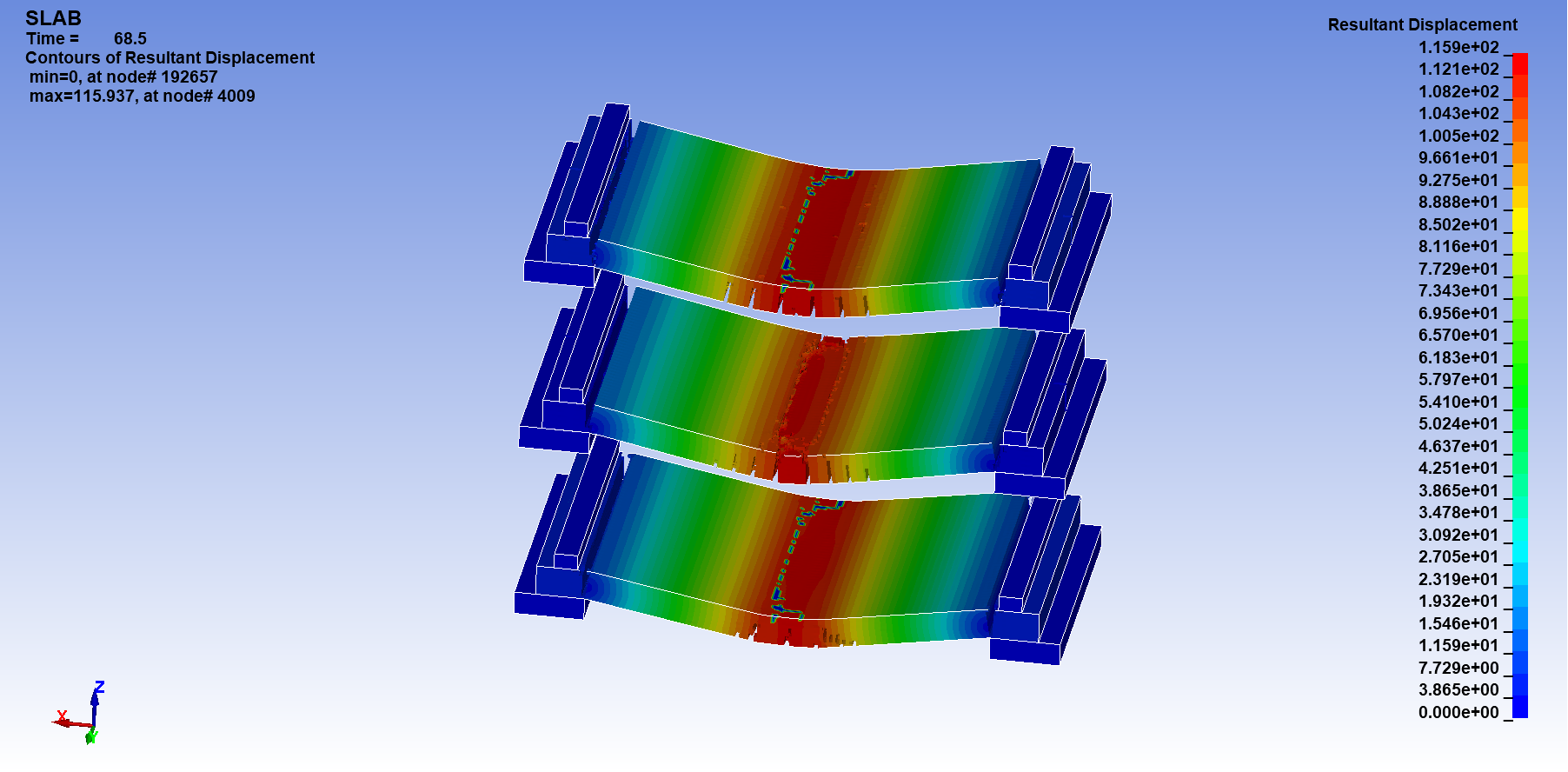
This work benchmarks my numerical simulations against the comprehensive experimental study 'Experimental Behavior of Reinforced Concrete Slabs Subjected to Shock Loading' by Ganesh Thiagarajan and Carol F. Johnson (ACI Structural Journal, 2014). Their work provides invaluable data on RC panels subjected to controlled blast waves, serving as the perfect baseline for validation.
https://www.concrete.org/publications/internationalconcreteabstractsportal.aspx?m=details&i=51686970
Replicating such complex experiments numerically using LS-DYNA presents a fascinating challenge, particularly in the realm of material model calibration. Accurately capturing the behavior of concrete and steel under high strain rates is crucial.
Here is a breakdown of our approach:
🔹 Selecting Constitutive Models:
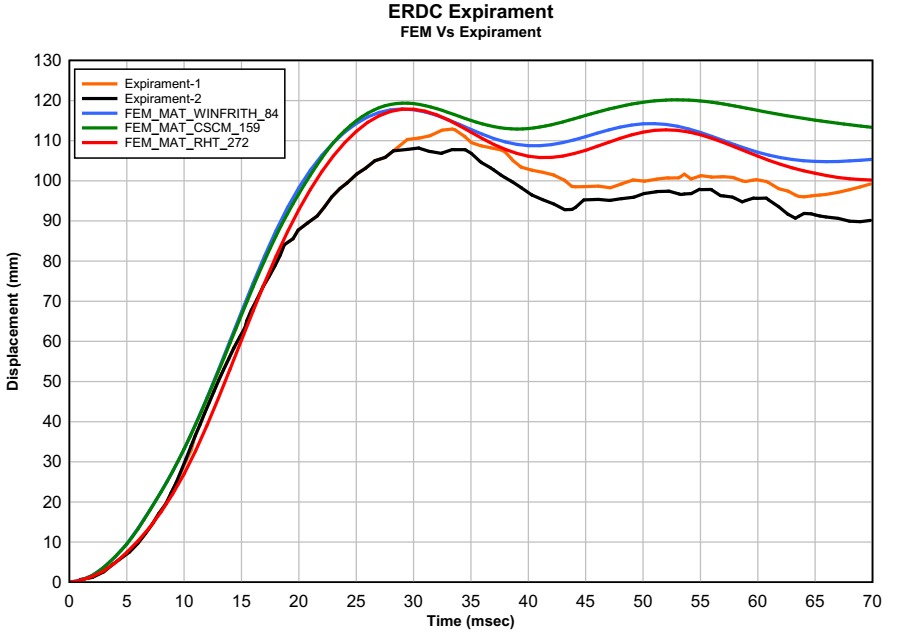
For concrete, we are evaluating multiple options including MAT_CSCM (159), MAT_WINFRITH (084), and MAT_RHT (272). Each has its own strengths regarding damage evolution and strain rate dependency. For the reinforcement, we are using MAT_PIECEWISE_LINEAR_PLASTICITY with strain rate effects (Cowper-Symonds parameters).
🔹 Parameter Tuning (The Art & Science):
This is where the real engineering happens. We are strictly adjusting parameters like unconfined compressive strength, fracture energy, and the Equation of State (EOS) to match experimental observations—specifically peak pressures, impulses, and deflection histories.
🔹 Validation:
Success is defined by how closely our simulation outputs align with the pressure-time histories and failure modes observed by Thiagarajan & Johnson. The goal is a calibrated model that can be confidently used for predictive analysis in future blast scenarios.
No comments yet. Be the first to share your thoughts!